Compressed-air nozzle atomization
Two-Fluid Spray Dryer
Liquid flows through a centre pipe while compressed air leaves the annulus around it at 200–340 m/s. The shear breaks the feed into the finest droplets of any atomizer.
How it works
Air shears the liquid into a fine mist.
The feed leaves the nozzle at under 2 m/s while compressed air around it travels at 200–340 m/s. The large speed difference creates strong friction that tears the liquid into very fine droplets.
Two-fluid nozzles suit small and medium capacities, sterile duty and viscous feeds. Atomizing power is 5–8 times that of a centrifugal atomizer, so they are chosen where fine powder matters more than energy cost.
- Finest powder, 5–50 µm
- Low and high viscosity feeds
- Simple, clean construction for sterile environments
- Easy to scale with several nozzles
- Three-fluid version for powdery emulsion explosive
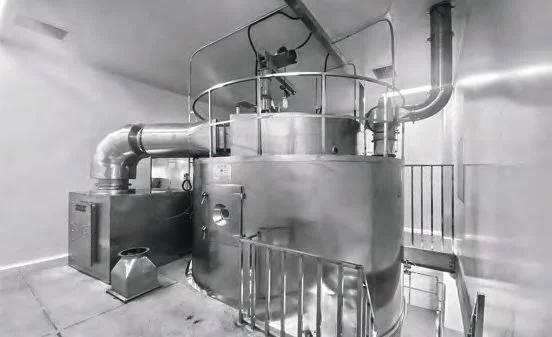
Process
From liquid feed to fine powder
- Supply airOil-free compressed air is filtered and metered.
- FeedA metering pump delivers the liquid to the nozzle centre pipe.
- AtomizeHigh-speed air shears the liquid at the nozzle exit.
- DryFine droplets dry almost instantly in the hot air.
- CollectHigh-efficiency cyclones and bag filters recover the fine powder.
Atomizing methods compared
Two-fluid against centrifugal and pressure
| Particle size | Two-fluid 5–50 µm · centrifugal 25–80 µm · pressure 48–250 µm |
|---|---|
| Energy | Atomizing power 5–8× centrifugal |
| Viscosity | Low and high viscosity |
| Capacity | Small to medium per nozzle; several nozzles for more |
| Tower | Height-to-diameter 1:1.2 to 1:1.5 |
| Maintenance | Simple; watch nozzles for blockage |
Source: Linzhou Dryer 2025 product brochure.
Typical materials
What two-fluid spray dryers are used for
Pharmaceutical
Fine chemicals
R&D
Explosives
Information we need
What to send us for a quotation
We do not sell spray dryers from a fixed model list. Every dryer is sized to the material, so these are the details our engineers ask for first.
| Material | Name, and what the powder is used for |
|---|---|
| Feed | Solids content (%), viscosity, temperature, solvent (water or organic) |
| Capacity | Powder output or water evaporation in kg/h, operating hours per day |
| Powder spec | Final moisture, particle size range, bulk density |
| Heat sensitivity | Maximum product temperature, if known |
| Site | Available heat source (steam, gas, electric, thermal oil) and building height |
If you are not sure about a value, leave it blank and we will work it out with you, or test a sample.
FAQ
Questions about this dryer
When is a two-fluid nozzle the right choice?
When you need the finest powder (5–50 µm), when the feed is viscous, or for sterile and small-batch duty such as pharmaceuticals and R&D.
Does it use more energy?
Yes. Compressed air makes atomizing power 5–8 times that of a centrifugal atomizer. The total depends on capacity; we calculate it for your case.
What is a three-fluid nozzle?
A variant with a second gas channel. We use three-fluid atomization with cold-air molding for powdery emulsion explosive.
Next step
Send us your material. We will size the dryer.
Tell us the material, solids content and the capacity you need. An engineer replies within one working day, and we can run a trial on your sample in our test center.