
Nitrogen closed-cycle · solvent recovery
Closed-Loop Spray Dryer
A sealed spray dryer that uses nitrogen as the drying gas and condenses the evaporated solvent for reuse. Built for organic solvents, oxygen-sensitive products and explosion-proof duty.
How it works
Dry with nitrogen, condense the solvent, reuse both.
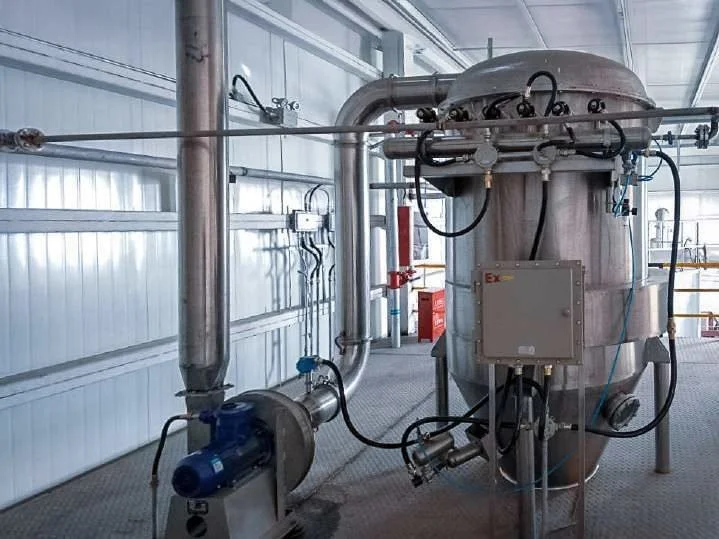
Nitrogen is heated and circulated through the drying tower. The feed is atomized into droplets that lose their solvent on contact with the hot gas. The gas then passes cyclones and a bag filter, and a condenser turns the solvent vapour back into liquid.
The non-condensable nitrogen is reheated and returned to the tower, so the system runs continuously without oxygen and without releasing solvent.
- Oxidation-free drying with nitrogen
- Recovers methanol, ethanol, acetone, hexane, ethyl and isopropyl acetate, dichloromethane
- Explosion-proof sensors and control
- Waste heat recovery and minimal emissions
Process
The closed nitrogen loop
- HeatA dedicated heater warms the nitrogen.
- AtomizeThe feed is pumped to a centrifugal atomizer.
- DryDroplets dry rapidly in the tower.
- SeparateCyclones and bag filters collect the powder.
- CondenseThe solvent is condensed and recovered as liquid.
- RecirculateNitrogen is reheated and reused.
Typical materials
Where closed-loop spray dryers are used
New materials
Batteries
Pharmaceutical
Solvents handled
Information we need
What to send us for a quotation
We do not sell spray dryers from a fixed model list. Every dryer is sized to the material, so these are the details our engineers ask for first.
| Material | Name, and what the powder is used for |
|---|---|
| Feed | Solids content (%), viscosity, temperature, solvent (water or organic) |
| Capacity | Powder output or water evaporation in kg/h, operating hours per day |
| Powder spec | Final moisture, particle size range, bulk density |
| Heat sensitivity | Maximum product temperature, if known |
| Site | Available heat source (steam, gas, electric, thermal oil) and building height |
If you are not sure about a value, leave it blank and we will work it out with you, or test a sample.
FAQ
Questions about this dryer
Which solvents can be recovered?
Methanol, ethanol, isopropyl acetate, ethyl acetate, dichloromethane, acetone and hexane, among others. Tell us your solvent and we check compatibility.
Why use nitrogen?
Nitrogen keeps oxygen out, which prevents oxidation of the product and removes the explosion risk of solvent vapour in air.
Is it only for solvents?
It is also used for oxygen-sensitive products in water, where inert drying protects product quality.
Next step
Send us your material. We will size the dryer.
Tell us the material, solids content and the capacity you need. An engineer replies within one working day, and we can run a trial on your sample in our test center.