
High-speed rotary atomizer
Centrifugal Spray Dryer
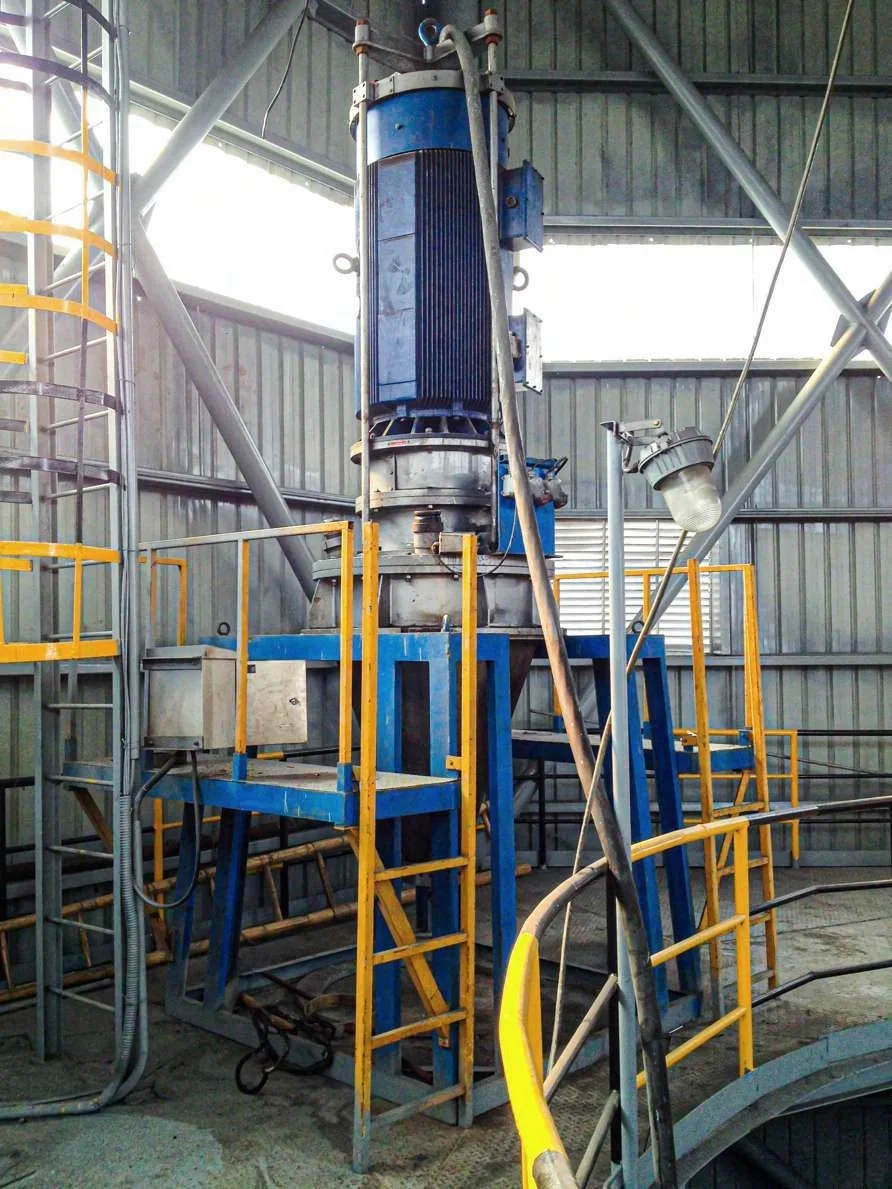
A disc spinning at high speed throws the feed into a fine, even spray. Centrifugal spray dryers are our core product, built from 5 kg/h lab units to plants with a single 60 t/h atomizer.
How it works
One atomizer, a wide tower, a narrow particle size.
Feed is pumped onto a disc spinning at high speed. Centrifugal force spreads it into a thin film that leaves the rim as a spray of droplets. The droplets meet hot air from the air distributor, dry in seconds and fall to the cone as powder.
Because a single atomizer can handle the whole feed, large plants stay simple. The spray travels sideways, so the drying chamber is wide, with a height-to-diameter ratio of about 1:1.
- Narrow particle size distribution, 25–80 µm
- Lowest energy use of the three atomizing methods
- One atomizer covers 2 kg/h to 60 t/h
- Disc speed sets droplet size without changing the nozzle
- Food-grade lubricant for food and pharmaceutical duty
Process
From liquid feed to powder
- Heat the airSteam, electric, gas, diesel, thermal oil or biomass heats filtered air.
- Distribute the airA hot air distributor gives an even flow around the atomizer.
- Atomize the feedThe feed pump delivers the liquid to the atomizer disc at the top of the tower.
- Dry in secondsDroplets dry in co-current contact with the hot air.
- Separate the powderCyclones, bag filters or wet scrubbers collect the powder and clean the exhaust.
Atomizer range
Centrifugal atomizers we build
We design and machine the atomizers ourselves. Three drive types cover lab to industrial scale.
| Spray capacity | 5 kg/h to 60,000 kg/h, over a dozen models |
|---|---|
| Drive types | Compressed-air turbine, mechanical gear drive, high-speed motor |
| Largest unit | 45 t/h national project; units above 30 t/h for chemicals and flue gas desulfurization |
| Lab and pilot | Dryers rated 5, 8, 10, 15 and 20 kg/h water evaporation |
| Monitoring | Oil temperature and oil pressure alarms on the atomizer |
| Control | PLC with touch screen, or DCS; multi-language interface |
Source: Linzhou Dryer 2025 product brochure. Final selection depends on your material.
Typical materials
What centrifugal spray dryers are used for
Chemicals
Batteries and new materials
Food
Environmental
Information we need
What to send us for a quotation
We do not sell spray dryers from a fixed model list. Every dryer is sized to the material, so these are the details our engineers ask for first.
| Material | Name, and what the powder is used for |
|---|---|
| Feed | Solids content (%), viscosity, temperature, solvent (water or organic) |
| Capacity | Powder output or water evaporation in kg/h, operating hours per day |
| Powder spec | Final moisture, particle size range, bulk density |
| Heat sensitivity | Maximum product temperature, if known |
| Site | Available heat source (steam, gas, electric, thermal oil) and building height |
If you are not sure about a value, leave it blank and we will work it out with you, or test a sample.
FAQ
Questions about this dryer
What capacities can a centrifugal spray dryer handle?
A single atomizer handles spray rates from 2 kg/h up to 60 t/h. Our lab units are rated 5–20 kg/h water evaporation, and production dryers reach 10–15 t/h evaporation.
What particle size does a centrifugal spray dryer produce?
Typically 25–80 µm with a narrow distribution. For coarser powder a pressure nozzle dryer is usually a better fit, and for finer powder a two-fluid nozzle.
Can it handle viscous feeds?
Low to medium viscosity feeds suit a centrifugal atomizer best. Very viscous feeds are usually better on a pressure or two-fluid nozzle. We confirm with a trial on your sample.
How tall is the drying tower?
Centrifugal towers are wide rather than tall, with a height-to-diameter ratio of about 1:1, which suits buildings with limited height.
Next step
Send us your material. We will size the dryer.
Tell us the material, solids content and the capacity you need. An engineer replies within one working day, and we can run a trial on your sample in our test center.